

Frequently Asked Questions
Important Notice: Information on this website is provided for general informational purposes only and is subject to change without notice. Nothing on this website guarantees eligibility, funding, approval, or any specific Program outcome. The Program reserves the right to modify Program Guidelines, application procedures, eligibility requirements, and other Program requirements at any time. In the event of any conflict between this website and the official Program and Application Guide, the official Program and Application Guide controls.
This is a Los Angeles County program run by the Department of Consumer and Business Affairs (DCBA). It provides financial help to eligible landlords (and in some cases displaced homeowners) who are dealing with unpaid rent, unpaid mortgage payments or other related expenses caused by an emergency or financial hardship.
- Landlords or property owners in Los Angeles County with unpaid rent or eligible expenses tied to emergency financial hardship.
- Tenants with unpaid rent including those impacted by the January 7th, 2025 Eaton and Palisades wildfire events or any other emergency financial hardships.
- Displaced homeowners from the January 7, 2025 Eaton and Palisades wildfire events who are now renting, have unpaid rent or mortgage costs and have exhausted FEMA or insurance rental support.
- Units located in the County’s “highest / high need” geographic designations via the Equity Explorer tool
- Small landlords owning four (4) or fewer rental units
- Property owners (or if unavailable, tenant households) whose household income is 80% or less of the Los Angeles County Area Median Income (AMI).
- Unpaid rent (rental arrears)
- Unpaid mortgage (for eligible homeowners/landlords)
- Other unpaid expenses separate from rent, that are directly related to the financial hardship caused by the emergency events
This program is now closed and applications are no longer being accepted. If you did not apply, you’re welcome to complete the Interest Form to receive updates about this program and any related rental assistance resources.
Assistance may cover up to six (6) months of rent debt. With limited exceptions, the maximum award is $15,000 per rental unit.
No. While the program specifically references the January 7, 2025 Eaton and Palisades wildfire events, it also allows for other types of emergency financial hardships, as long as eligibility requirements are met.
- Tenant participation is required for all applications, regardless of who starts the process.
- Tenants may now initiate an application by submitting their required information through the application portal.
- If a landlord starts the application, the tenant will be invited to complete their required portion.
- Likewise, if a tenant starts the application, the landlord will be required to complete their portion.
- Important Note: An application will not be considered complete or reviewed until both the tenant and the landlord have submitted their required information.
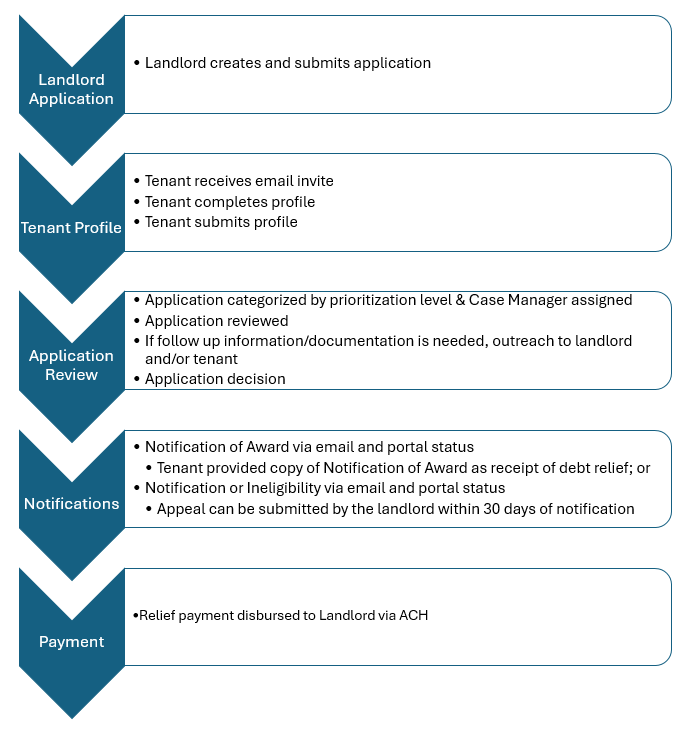
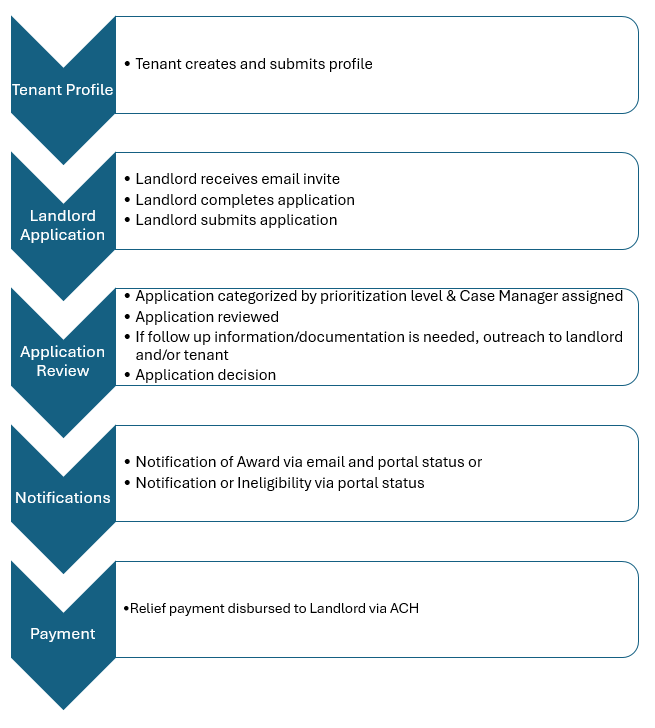
The Los Angeles County Emergency Rent Relief Program is a program targeted toward landlords. A landlord must submit a complete application to be considered for a grant. If the landlord refuses to participate, the unit(s) will not be eligible for a relief grant through this program.
Tenant participation is required to verify information. If a tenant refuses to complete the Tenant Profile, the Program may be unable to confirm eligibility, and the landlord’s application may not be approved.
Immigration status is not required for eligibility.
The County recognizes that some households are experiencing serious financial hardship because an income earner was detained due to recent federal immigration enforcement activities. Because of the impact these situations can have on families, the Program aims to make sure these households are not excluded from assistance.
If a household states that its financial hardship is related to an immigration detention or deportation, the Program may ask for documentation to confirm this. If this documentation is not available, or if the household chooses not to provide it, the household may still be eligible for rent relief based on other forms of economic hardship.
Payment will be issued by direct deposit (ACH) to the bank account provided during the application process.
Yes. The Primary Applicant must be 18 years of age or older.
Yes. The program’s Local Partner Network will help applicants who need assistance completing their applications by phone or in person.
You do not need your own computer to apply. The Local Partner Network will provide help by phone or in person for people who cannot apply online. Details will be posted on the Program website when the application opens.
No. The Program is not first come, first served. Applications are reviewed based on eligibility and priority factors.
Once an application enters “active review” and all required follow-up steps are completed, a decision may be made within about 30 days.
Final requirements will be listed in the application portal. Landlords may be asked to provide:
- Proof of property ownership
- Rental agreements
- Payment records showing unpaid rent
- Documents related to emergency-related financial hardship
No. Applying does not guarantee funding. Awards depend on eligibility, priority status, and available funds.
If funding is exhausted, some eligible applicants may not receive an award.
For questions about tenant protections, eviction rights, rent increases, counseling, or referrals, please contact the Los Angeles County Department of Consumer and Business Affairs (DCBA) at (800) 593-8222.
Please note: DCBA cannot assist with Program application-specific matters, including application status, eligibility or denial decisions, reopening applications, document submissions, or requests for immediate rental assistance through the program. For all questions related to your application, please contact the program Call Center at (877) 849-0770. Representatives can assist with application-specific inquiries and provide information about the program process.
Yes. Displaced homeowners whose mortgage is in forbearance may still be eligible for a grant, provided they agree to use the awarded funds to pay their mortgage.
Yes. Tenants will be notified if their unpaid rent is approved for payment through the program. Once the application is approved, tenants can view the updated status in the application portal and will also receive a copy of the approval notice by email, which includes the approved amount.
For a landlord to remain eligible for this program, the tenant must still be residing in the rental unit. If the tenant is evicted and is no longer living in the unit, the landlord would not be eligible for the program.
If there is an active Unlawful Detainer (UD) or eviction proceeding for non-payment of rent, the landlord may be required to:
- Complete a Program attestation agreeing to act in good faith
- Dismiss the active UD for non-payment of rent upon receipt of the award
- Submit documentation confirming dismissal of the eviction proceeding
Required dismissal documentation must be submitted within 30 days of receiving rent relief funds. Failure to comply with these requirements may result in the landlord becoming ineligible for funding or the initiation of recapture of awarded funds.
- Tenants who signed a sublease are not considered the “tenant of record” for this program therefore, ineligible.
- If you are a subtenant, the property owner may still be eligible to apply for assistance based on rent owed by the primary tenant under the original lease. Any rent owed between a subtenant and the primary tenant is not covered by this program.
This program is now closed and applications are no longer being accepted. If you did not apply, you’re welcome to complete the Interest Form to receive updates about this program and any related rental assistance resources.
Yes. You may receive an IRS Form 1099 for tax reporting purposes if you receive grant funds. If required under federal tax rules, the program will send you a 1099 by January 31 of the following year for the total amount you received. The form will be sent to the mailing address associated with your application.
Grant funds may be considered taxable income depending on your individual circumstances. The program does not provide tax advice. If you have questions about how this affects your taxes, please speak with a tax professional or contact the IRS. You are responsible for reporting any taxable portion of the grant to the Internal Revenue Service (IRS) and applicable state tax authorities. If your address changes after you receive funds, please notify the program to ensure you receive any tax documents.
Important Note: The County of Los Angeles and The Center by Lendistry, including its affiliates, do not provide tax, legal or accounting advice. This material has been prepared for informational purposes only and is not intended to provide, and should not be relied on for, tax, legal or accounting advice. Readers should consult their own tax, legal and accounting advisors before completing their tax filings.
The payment process has been updated for Round 2 of the Los Angeles Emergency Rent Relief Program. Landlords/property owners will not be asked to provide banking information when submitting an application. If your application is approved, you will receive a notification with instructions to provide your banking information through the program’s secure portal so your payment can be deposited.
No. Landlords/property owners who already submitted banking information into their application do not need to update or resubmit their account or routing details.
If you are a landlord or displaced homeowner and disagree with the program’s decision on your application, you may submit an appeal within 30 days of the date on your decision notice. Appeals submitted after the 30-day deadline will not be considered.
The program will begin reviewing your appeal no later than 30 days after it is submitted. Once the review begins, a final determination will be issued within 30 days. You will be notified of the outcome once the review is complete.
Note: The appeals process is available to landlords and displaced homeowners only.